Platform comparison
| Platform | YES odds | NO odds | Fee | KYC | Settlement | |
|---|---|---|---|---|---|---|
Polymarket (via BTC Prediction) Pick polygram.ink (preferred broker) |
50% | 50% | 0% (USDC on-chain) | No-KYC up to $1,500 | USDC, auto via UMA oracle | Open live market → |
Polymarket (direct) polymarket.com |
50% | 50% | 0% | Geo-blocked in US/UK/EU | USDC, on-chain | Open live market → |
Kalshi kalshi.com |
— | — | Up to 7% per trade | US-only, KYC required | USD | Open live market → |
Betfair Exchange betfair.com |
— | — | 2-5% commission | Full KYC from first trade | GBP / EUR | Open live market → |
Manifold Markets manifold.markets |
— | — | Play-money (mana) | None — play-money | Mana (no cash-out) | Open live market → |
Outcome probabilities
Current market-implied probability for each outcome, from the live order book.
| Outcome | Probability |
|---|---|
| A | 50% |
| B | 50% |
| C | 50% |
| D | 50% |
| E | 50% |
| Other | 50% |
| BLG | 32% |
| HLE | 26% |
| T1 | 13% |
| GEN | 12% |
| KC | 12% |
| WE | 10% |
| DCG | 6% |
| TLAW | 5% |
| LYON | 3% |
| NIP | 3% |
| G2 | 1% |
| TES | 1% |
| JDG | 1% |
| DK | 1% |
| AL | 0% |
| KT | 0% |
| FLY | 0% |
| WBG | 0% |
| TSW | 0% |
| CFO | 0% |
| C9 | 0% |
| MKOI | 0% |
| IG | 0% |
| GAM | 0% |
| BFX | 0% |
Market context
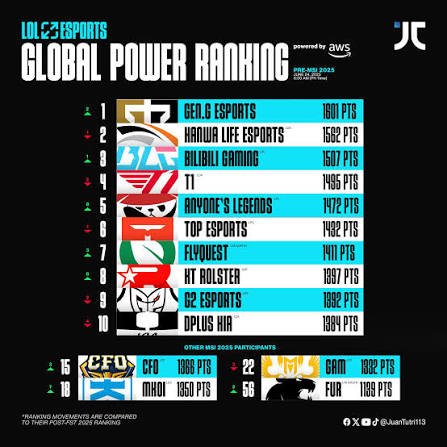
The relevant event is the final **2026 LoL Esports Global Power Rankings** release after Worlds, with the market paying out on whichever team is listed first at number one, or alphabetically if there is a tie. The current crowd price of **26% YES** sits close to the live market view of **BLG at 26%** on Polymarket, while an external rankings snapshot currently shows **Hanwha Life Esports** marginally ahead of **BLG** and **Gen.G** at the top of the 2026 table, which helps explain why this contract is priced as a competitive three-horse race rather than a one-team lock.[4][5]
Comparable cases suggest the market is mostly about whether the post-Worlds rating system rewards season-long consistency or late-year international form. Riot’s Global Power Rankings are presented as an official, data-driven ladder powered by AWS, and they are updated through the competitive year rather than decided by a single tournament result, so traders usually watch for how Worlds runs alter the final weighting rather than assuming the champion automatically finishes first.[2][10] The 2026 running order has already shifted multiple times across the year, with BLG, HLE, GEN and T1 all appearing near the summit in recent snapshots, which means small changes in Worlds results or tie-break ordering can matter more than headline narratives.[3][5][9]
Catalysts are straightforward: Worlds bracket results, any official Riot explanation of the final post-Worlds ranking methodology, and the timing of the last published 2026 table before year-end settlement. Because this is an on-chain USDC market, the contract can reprice sharply around key matches, and broader crypto conditions may affect liquidity even though the payoff is tied only to Riot’s published ranking; at present, BTC and ETH are trading as the main macro risk gauges, while prediction-market attention tends to cluster around the highest-volatility Worlds weeks rather than the earlier regular season.
Methodology
Methodologically this overview focuses on on-chain pricing: Polymarket's live mid comes from the Polygon conditional-token order book and settles automatically in USDC. The other three venues — Kalshi, Betfair, Manifold — sit alongside as off-chain reference points so you can see how the contract translates across regulatory and settlement regimes.
Resolution & payout
Settlement is on-chain via UMA Optimistic Oracle. A proposer posts the outcome with a bond, a two-hour dispute window opens, then the smart contract lifts winning conditional tokens to 1 USDC and sends payments to holders' wallets automatically. No withdrawal fees beyond Polygon gas.
Off-chain venues (Kalshi, Betfair, Smarkets) settle in local fiat through bank-side clearing — faster than SWIFT, slower than on-chain. Manifold pays no real cash.
FAQ
- What are crypto prediction markets?
- Crypto prediction markets are on-chain smart contracts where you buy YES or NO shares on a future crypto event (e.g. "BTC above $100k by year-end"). The market price between 0¢ and 100¢ is the implied probability.
- Why USDC and not ETH or USDT?
- USDC is the Polygon standard — audited reserves (Circle, monthly attestation), deepest order book, low gas costs. ETH volatility would distort probability quotes; USDT has thinner Polygon liquidity than USDC.
- Can I use Bitcoin directly?
- No, Polymarket operates exclusively in USDC on Polygon. You can bridge BTC to USDC via an exchange or bridge service and deposit on Polygon — typically 10-30 minutes processing time.
- How does UMA secure the resolution?
- The UMA Optimistic Oracle uses a bond system: a proposer posts a bond, a two-hour challenge window opens. On dispute the losing side forfeits the bond — financial incentive for honest resolution.
- How volatile are crypto prediction markets?
- Crypto markets react to spot prices — a 5% BTC move typically shifts a "BTC above X by date" market 10-20%. Polymarket crypto market liquidity is usually six-figure USD, sufficient for active trading.
%22%2F%3E%3Cpath%20d%3D%22M%206%2066%20A%2026%2026%200%200%201%2058%2066%22%20fill%3D%22%23E6B98D%22%20opacity%3D%220.9%22%2F%3E%3Ccircle%20cx%3D%2232%22%20cy%3D%2226%22%20r%3D%2222%22%20fill%3D%22%23F5CBA7%22%2F%3E%3Cpath%20d%3D%22M%2010%2026%20A%2022%2028%200%200%201%2054%2026%22%20fill%3D%22%23fbbf24%22%20opacity%3D%220.9%22%2F%3E%3C%2Fsvg%3E) and
and%22%2F%3E%3Cpath%20d%3D%22M%206%2066%20A%2026%2026%200%200%201%2058%2066%22%20fill%3D%22%23E6B98D%22%20opacity%3D%220.9%22%2F%3E%3Ccircle%20cx%3D%2232%22%20cy%3D%2226%22%20r%3D%2222%22%20fill%3D%22%23F5CBA7%22%2F%3E%3Cpath%20d%3D%22M%2010%2018%20Q%2016%204%2026%2010%20Q%2020%202%2032%206%20Q%2044%202%2038%2010%20Q%2048%204%2054%2018%22%20stroke%3D%22%23fbbf24%22%20stroke-width%3D%224%22%20fill%3D%22none%22%20stroke-linecap%3D%22round%22%2F%3E%3C%2Fsvg%3E)
Trade League of Legends Global Power Rankings Post Worlds:… on BTC Prediction
Live order book, 0% fees, USDC settlement in seconds.
Open live market →