Market statistics
- Total volume
- $13.3M
- 24h volume
- $472K
- Liquidity
- $313K
- Open interest
- $3.0M
Platform comparison
| Platform | YES odds | NO odds | Fee | KYC | Settlement | |
|---|---|---|---|---|---|---|
Polymarket (via PolyGram) Pick polygram.ink (preferred broker) |
16% | 84% | 0% (USDC on-chain) | No-KYC up to $1,500 | USDC, auto via UMA oracle | Open live market → |
Polymarket (direct) polymarket.com |
16% | 84% | 0% | Geo-blocked in US/UK/EU | USDC, on-chain | Open live market → |
Kalshi kalshi.com |
— | — | Up to 7% per trade | US-only, KYC required | USD | Open live market → |
Betfair Exchange betfair.com |
— | — | 2-5% commission | Full KYC from first trade | GBP / EUR | Open live market → |
Manifold Markets manifold.markets |
— | — | Play-money (mana) | None — play-money | Mana (no cash-out) | Open live market → |
Outcome snapshot
Current YES/NO probability from the live order book.
Market context
The Strait of Hormuz, through which roughly one-fifth of global seaborne oil passes, has experienced sustained disruption since late 2023 owing to Houthi attacks on shipping and subsequent regional tensions. Transit calls—measured as arrivals of container, dry bulk, roll-on/roll-off, general cargo, and tanker vessels tracked by IMF Portwatch—have remained well below the 60-vessel 7-day moving average that constitutes "normal" traffic. The market requires this threshold to be reached by end-June 2026 for a Yes resolution, currently priced at 18% probability, reflecting trader scepticism about near-term normalisation.
Historical precedent suggests Strait disruptions persist longer than initial expectations. The 2019 tanker attacks saw traffic recover gradually over months rather than weeks, whilst the 2011 Iran sanctions regime took years to fully unwind. Current transit volumes remain depressed despite temporary ceasefires and diplomatic efforts, indicating structural reluctance among shipping operators to resume full passage. Comparable geopolitical chokepoint disruptions—the Suez Canal blockage in 2021 or the Panama Canal drought in 2023—took 6–12 months to fully normalise, setting a baseline for how long market participants expect Hormuz recovery to require.
Traders should monitor announcements from the International Maritime Organization regarding shipping corridor safety assessments, any escalation or de-escalation in regional military activity, and IMF Portwatch's weekly data releases for trending direction. Oil futures pricing and tanker rate indices (tracked on Bloomberg and Refinitiv) often lead shipping volume changes. On-chain settlement in USDC creates direct exposure for crypto traders holding macro positions; elevated geopolitical risk typically correlates with BTC strength as a hedge, though sustained Hormuz closure would likely pressure energy-linked assets and broad risk appetite.
Wikipedia Context
-
 Strait of Hormuz
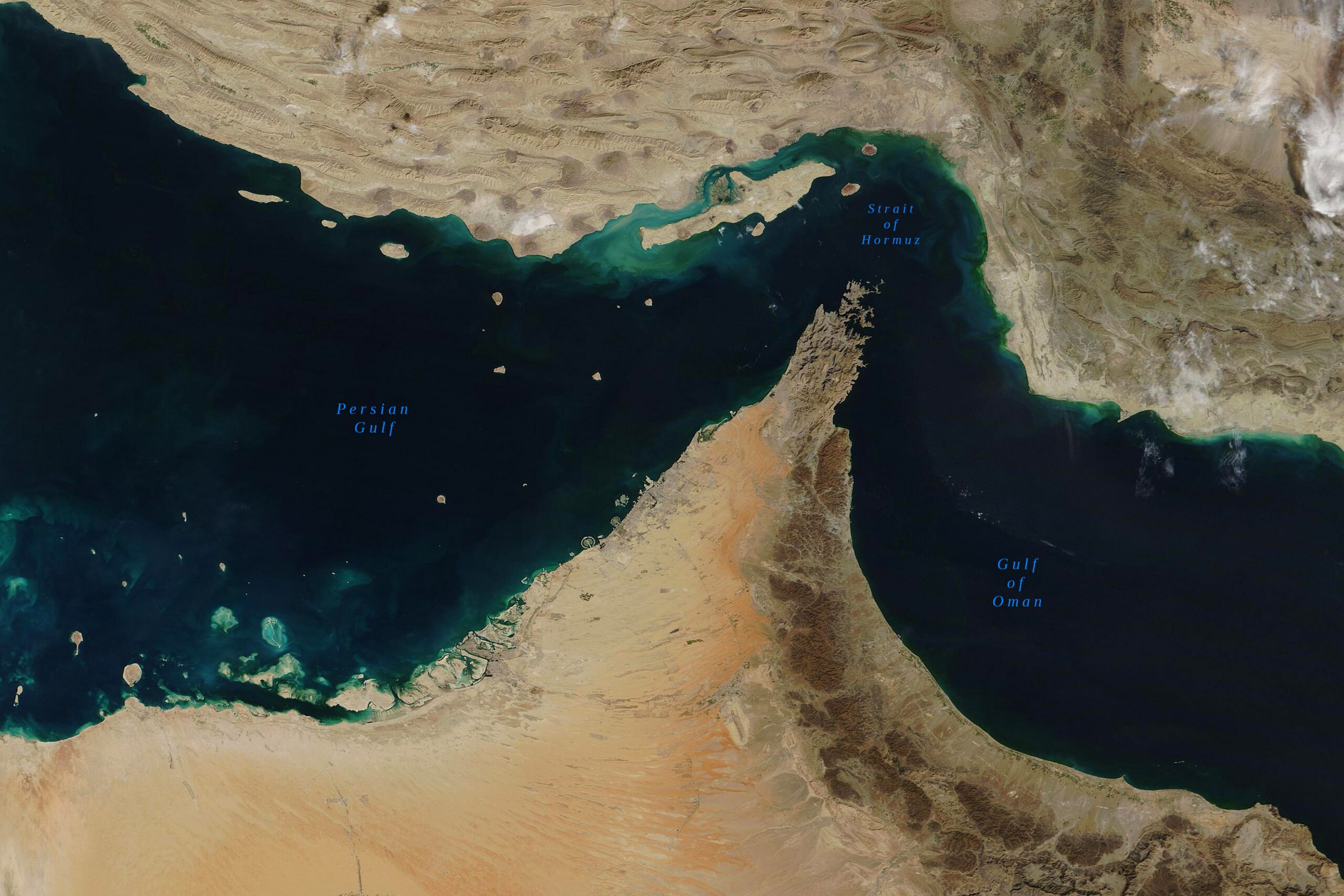
The Strait of Hormuz is a waterway between the Persian Gulf and the Gulf of Oman. On the north coast lies Iran, and on the south coast lies the Musandam Peninsula under the Musandam Governorate of Oman, with a portion of the southwest of the peninsula under the United Arab Emirates. The strait is about 104 miles long, with a width varying from about 60 mi to
-
 Battle of the Strait of Hormuz (1553)
The Battle of the Strait of Hormuz was fought in August 1553 between an Ottoman fleet, commanded by Admiral Murat Reis, against a Portuguese fleet of Dom Diogo de Noronha. The Turks were forced to retreat after clashing with the Portuguese.
-
 2026 Strait of Hormuz crisis
Shipping traffic through the Strait of Hormuz, a major maritime choke point for world energy trade, has been largely blocked by Iran since 28 February 2026, when the United States and Israel launched an air war against Iran and assassinated its supreme leader, Ali Khamenei. In retaliation, Iran launched missile and drone attacks on Israel, US military bases,
Methodology
Methodologically this overview focuses on on-chain pricing: Polymarket's live mid comes from the Polygon conditional-token order book and settles automatically in USDC. The other three venues — Kalshi, Betfair, Manifold — sit alongside as off-chain reference points so you can see how the contract translates across regulatory and settlement regimes.
Resolution & payout
Settlement is on-chain via UMA Optimistic Oracle. A proposer posts the outcome with a bond, a two-hour dispute window opens, then the smart contract lifts winning conditional tokens to 1 USDC and sends payments to holders' wallets automatically. No withdrawal fees beyond Polygon gas.
Off-chain venues (Kalshi, Betfair, Smarkets) settle in local fiat through bank-side clearing — faster than SWIFT, slower than on-chain. Manifold pays no real cash.
FAQ
- What are crypto prediction markets?
- Crypto prediction markets are on-chain smart contracts where you buy YES or NO shares on a future crypto event (e.g. "BTC above $100k by year-end"). The market price between 0¢ and 100¢ is the implied probability.
- Why USDC and not ETH or USDT?
- USDC is the Polygon standard — audited reserves (Circle, monthly attestation), deepest order book, low gas costs. ETH volatility would distort probability quotes; USDT has thinner Polygon liquidity than USDC.
- What does a transaction cost on Polygon?
- Polygon gas is typically under $0.01 per transaction. A full trade cycle (Approve + Order + Fill) totals around $0.03 — compared to $5-50 on Ethereum mainnet.
- How does UMA secure the resolution?
- The UMA Optimistic Oracle uses a bond system: a proposer posts a bond, a two-hour challenge window opens. On dispute the losing side forfeits the bond — financial incentive for honest resolution.
- Which crypto markets exist on Polymarket?
- Currently active markets include BTC/ETH/SOL price targets, halving dates, ETF approvals, hard-fork outcomes and Layer-2 TVL thresholds. The list updates weekly; biggest volume sits on BTC and ETH price forecasts.
Trade Strait of Hormuz traffic returns to normal by end of… on PolyGram
Live order book, 0% fees, USDC settlement in seconds.
Open live market →